108. Where Are All the Journeyman Researchers?
(Epistemic status: The past isn't dead; it's not even past. Steelmanning labor and education systems of yesteryear and nowadays both; one holds up and the other fails. Planning in public, but, like, quietly. For everyone who's ever been called an overgrown junior or an underbaked senior... and Ray Bradbury, and his soft rains as came.)
The guild systems had three ranks, and almost everyone I've ever talked to remembers the wrong two. They're not to blame, and neither is the English language; it's one of those cases where society found an answer and then forgot it again. "Apprentice" and "master" survive just fine: we still say that a chef "apprenticed under" someone else, and we still talk about "masterpieces". Few people still talk about the middle rank, though; indeed, it has almost totally vanished from the language, to the point that most are surprised to learn that "journeyman" was ever a rank at all, and not just another word for "competent hireling". Once more, with feeling: "journeyman", from "journée" - French for day - as they were paid by the day. The wage is in the name - hold on to that; it'll be load-bearing later - but it's by no means the end of the story.
So... what is a journeyman, anyway, if not just a word for a skilled day-laborer? To understand it in full, let's walk briskly through the guild system's training track entire, from start to finish. (And remember: this is how things were supposed to work; we'll judge systems by their practices under reasonably functional conditions.) No matter the trade, be it silversmithing, woodworking, tailory, or chandlery, the story was much the same. Everyone starts as an apprentice: unskilled as yet, but with promise. An apprentice is bound to a single master; they learned by doing, and were compensated not in wages but in room, board, and mentorship. After they acquired basic competence as judged by that master, they became a journeyman: having been certified in a basic level of competence in their trade, they were at last paid a real wage, and free - free to travel and to learn from other masters, and indeed encouraged or even required to. In Germanic lands, this became formalized as the "Wanderjahre" - the wandering years. Wherever they went, they were accompanied by an official letter of introduction from a master they'd worked under; a travelling certificate that they knew their basics and could be trusted with professional work for professional pay. After a while of this, working here and there and learning all they could from assorted masters, they produced a masterpiece: a specific, judged work as a crowning achievement synthesizing all they'd learned and powered by the skills they'd honed. If all went well - and it usually did - then the guild masters examined it, approved, and let him settled down and hang a sign. Now a master, they owned their own shop, peddled their trade, took apprentics of their own, and taught journeymen passing through now and again; the cycle repeats.
(I ask that the labor and economics historians lower their pitchforks and extinguish their torches and dump out their buckets of tar. Yes, the guild system was a terrible blight in many ways; they were often rent-seeking cartels that charged ruinous entry fees, excluding apprentices and discriminating against journeymen by blood or creed, and fixing prices so blatantly that it'd make an SEC regulator spit out their latte. I'm steelmanning on purpose here. Even if it's just their sales pitch that beats our reality, we should still have them beat easily with another half-millennium on them of mechanism design and pedagogy. We don't, and that's an indictment that should keep some of you up at night.)
Note a few major important beats in the journeyman's verse that have gone discordant in the modern day version. First, a journeyman was generally required to travel around, learning all they could, before they were even permitted to attempt their masterpiece. That old system understood what we've now largely forgotten: technique - especially the kind imparted by implicit transfer and honed by practice - doesn't live in any one shop, or any single lab. A journeyman who learned how silver was shaped in Nuremberg and also in Paris knew things that no single master could have taught them; the guilds made that a precondition of mastery, not a liability on a CV. And a journeyman, once certified as competent, was generally treated as competent: certified already, not under permanent probation, not someday, not the sempiternal "we'll see after a few more rotations".
Compare this to research in the modern day, which - bless its heart - still pretends to have this ladder. Obviously, the doctoral student - from MS to PhD - is the apprentice: bound to a single advisor, learning by doing, paid in stipend and instruction. (And my steelmanning is even-handed here: I'll even grant the assumption that the instruction is light and necessary, valuable mentoring experience and sharing of flame; that the stipend is sufficient, not the kind of starvation wages that repeatedly spark strikes.) The tenured or tenure-track PI is the master, equally clearly: they own a "shop" - a lab, a grant, a letterhead, a research group - and they take apprentices, and they were admitted by judged work - not a thesis, but further strong publications and results, judged by some hiring committee. Notionally, the role of journeyman is played by the humble postdoc: the non-tenure track faculty. Let's check the properties. Are they paid fairly? Hardly; non-tenure track positions are infamously the worst-compensated rank relative to skill in all of academia, let alone the knowledge economy; half the time, they're glorified adjuncts. Already certified, then? Not a chance: the postdoc is a perpetual audition, a position defined by "not yet" and "keep moving" and "no room in the budget", called on to repeatedly rip up their life on a two- or three-year timetable, if they're lucky; not yet hireable, not yet independent, not yet accorded as real. What about freedom to wander? Quite the opposite - they're bound all the more tightly to a single master's grant, working that master's agenda, and accumulating citations for that master, if they're even lucky enough to be put to work on research at all rather than treated as fungible service-course labor. Here's the worst tell of all: what does it look like when a postdoc moves from position to position, moving between labs and institutions and even fields, collecting methods the way the system's own ancestors would have demanded as unexceptional? Hiring committees don't read them as pursuing Wanderjahre excellence - they wonder why no one else snapped them up years ago. They see such postdocs as damaged goods. "Yeah, he clearly couldn't hold a post. No sustained line of work, and too few publications for this far out of a PhD. Who even sent this guy?" And all of this is with the academic system working as intended!
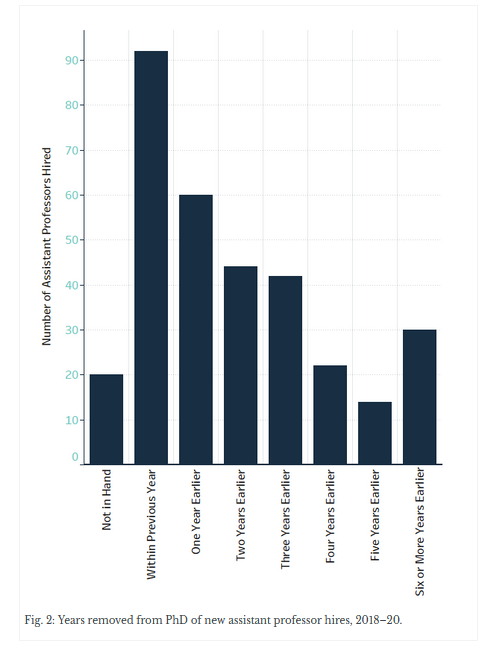
Worse yet, the rank has no single name. "Research assistant professor", "postdoctoral fellow", "postdoctoral research associate", "visiting professor" chairs named after some donor. It's all a shell game. The rank's got no name because the rung is missing, and you can stare into the associated howling void from any angle you like. It's why postdocs are miserable at rates the surveys keep blithely pointing out without ever doing anything about it; it's why every research organization you can name is a school or a lab - an apprenticeship, or else a working shop - with nothing in between; it's why the load-bearing travel and wandering of the historical system gets punished; it's why "independent researcher" is largely a polite euphemism for "unfundable" in academia and "hope you know someone or this is going to be rough" in AI safety, no matter how certified and productive they are, given their lack of affiliation; really, they'd better find a home.
Ah, AI safety. My own strange corner, these days. In this as in many things, we (they? we? we.) imported all the failures of academia wholesale and then, having perfected them, came up with brand new ones, too; our fellowships mint new apprentices by the cohort with tear-eliciting effectiveness and then ship them out to fall into the cracks, because the destination rung is missing; because work at a top lab is nice work if you can get it; because "just found an org" is just another way of saying "good luck; you're no longer my problem".
So if the problem is so clear, why doesn't anyone simply fix it alone? It's certainly not stupidity, it's probably not a lack of creativity, and I hope it's not a matter of malice. Clearly it's not a matter of a lack of personnel, so I think that it's a matter of the missing rung being bottlenecked on trust. A potential funder - public, private, philanthropic, whatever - can't cheaply verify an individual wanderer; trust at scale requires intentional manufacture. Worse luck, the letter of introduction has morphed into the letter of recommendation: semantically bleached not just into uselessness but a kind of obligatory non-condemnation; you'd better hope that whoever writes yours knows how to play the requisite game of formulaic exaggeration and unconditionally glowing praise and not-quite-lying... no room for many bits of actual signal there. And there's no testing for research taste or aesthetics with a form, either: results arrive on their own schedule and no quarterly report can handle that. So the Scrooge-McDuck-sized grants all flood the schools and the fellowships and the occasional shop, because all of those come with trust pre-built; the places with initiation costs, shared canon, and skin in the game. But this is precisely the kind of trust-boundary technology that a guild was built for: costly initiation, examined work, a shared canon of techniques and knowledge, and a reputation that the entire membership staked on every member; that way, a master in London could hire a Swiss journeyman he'd never met, just on the strength of the mark. A guild was historically neither club nor a business concern nor a club: it was a manufactured trust boundary, meant to solve the same sort of problem universities once considered themselves to have standing to tackle. We didn't lose the journeyman because society outgrew the need for him - we lost them because the boundary-technology that made them findable and fundable crumbled a century or two ago, and nothing replaced it.
So here's a pitch for a solution, in very broad strokes: a journeyman's hall for researchers, especially AI safety. (Especially agent foundations.) Certification that means "already" - an examination, once, legibly, by people with standing, rather than the constant exhaustion of re-auditions and endless interviews; perhaps even the return of actual meaningful letters of introduction, alongside or instead. Wages by the day, because the day is the honest unit of a wanderer's labor - perhaps by way of paper preparation, light factual research, and brainstorming for hire - and a culmination towards a masterpiece, especially now that travel is so much cheaper and faster and at worst there's videocalls. For some extra tech, research-managers-at-large, whose own dedicated craft is unblocking stuck research, with a variety of different specialties, shared across the membership in a way that no small research org could ever afford, never mind a single independent researcher. And one last piece I'd defend at extreme cost: a library of stall-points. Documented dead-ends, negative results, and half-finished proofs; witnesses of partial work, kept rough and unfinished - better than discarded. Such would be kept as guild property, so that a member's worst year might still leave a blaze on the trail, and the next wanderer inherits a map rather than a rumor - and so that they might tell mile-marker from tombstone from grave-goods-loaded mausoleum. And above all else, wandering restored to being the point: members circulating between shops and problems and fields on purpose, working with each other and going off elsewhere for a bit and rejoining, because that technique-accumulation was always the point, and the hall might exist so that "on to my next adventure" is truly heartfelt and not just a saccharine status update. All of this, I state ownerlessly: in this as in many things, I am consequentialist, and just want for this to exist.
I will cheerfully admit to an unfinished design with open problems. If I didn't, you wouldn't believe me, or shouldn't; I am not in the business of peddling brochures and getting people to believe in things I don't, that I haven't checked over carefully. I have no full answer for the accumulated damage in the people that this hall would seek to serve; they are many of them injured. The research world is rife with walking wounded, burned by scooping, by bad or neglectful advisors and mentors, by the grind of being asked to apply for a position and then immediately rejected. Those who've been used like kindling need more than clever mechanism design, and bootstrapping a trust-institution for the trust-injured, paying down those abandoned debts others have left, would be hard and expensive. I don't know the right way to test for research taste, either; certification of research aesthetics is a question of journeyman competence wearing an administrator's coat. It's hard. Maybe too hard, even in principle. I don't know how small is too small to carry a trust boundary, or how large is too large to retain one. "The library fixes priority and discoverability issues" is half an answer, if even that. Research time is long and unpredictable and log-normal, and the funding model I sketch out - paying day-wages against results that come in years if lucky - needs a treasury model that I can sketch out but not yet prove; a funder with few strings attached would naturally make that part easier. If you've read this far with your teeth set, you probably see several more failure modes. I'm asking for them, specifically; ignorance is no defense here. I want this idea to be as good as it could be.
Here's the thing: I speak from experience here. I wish I had this. I wish this already existed. I have been burned and starved, repeatedly, by its lack, and I could rattle off half a dozen names of others, better researchers than me, that have been burned worse, driven away altogether. I defended my own thesis in late 2021, during lockdown; wandering ever since between fellowships and programs and grants and independent work, under five institutions' roofs in as many years. I've been paid by the day in the several ways our fallen system pays, accumulating technique across fields in a way that an older system would have required and that this one penalizes. I have no masterpiece. Maybe it's only pending, but I doubt that our present world yet contains the room in which it would be fitly judged. And I trust this sketch at all, this design for a small hall of this sort, because I did so before I learned its name - sketched out the roles and the records and the wage-logic all from scratch, seeking to do right by whoever else came along to build it; only afterwards did I find the medieval frame sitting right there, fitting like a die around my existing cast. Surely the evolution of the same shape twice points at a real niche? But the timeline for my shot at this is loose. The funding is unfound. The founder is... unfortunately unproven. I tell you all of this as disclosure, as the very opposite of recruitment... but all the same, in the way that you might tell someone appraising a fire that you own a bucket, perhaps in need of a quick patch. But once more: the design belongs to that void's whole population; not just to me. This needs a bus number well greater than one.
And someone will build this, I'm sure of it; this, or something like it. I know it the same way you can spot a vacant niche from the creatures pacing its edge; I have met others halfway through their own rederivations, ornamented a little differently. The hall will not stay unbuilt; convergent evolution makes no habit of filing one-offs, and I have met many of those pacing restless creatures, certified and wandering and day-worthy and nameless. The only open question about them is just how many of them we lose to the void in the meantime. The only open question about the hall is whether it gets built well: with its hard parts named and its warranty honest, or else whether it gets built as yet another glossy brochure by whoever gets there first with the fewest scruples about the difference, about selling something they don't care to deliver on.
All the same, no trumpet, no summons, just this: I keep a list, these days. Fellow journeymen on one page; those would would step up to fund such a hall on the other, if one stood. One page is short, and the other is far shorter. Both are growing, if slowly. If you've bounced off the same problem I see from the funder's side - if you've ever sought to back a wanderer and found no instrument for doing so, of overcoming the trust gap - then the mechanism above is that instrument's spec sheet, and my address can be easily found. And if you're the other sort of reader - a certified competent wandered, sick of yet another interview question that smells like process and traps and "who sent this guy" and a disregard for your very finite time - then take heart in the only thing that this post can pay out today: it's not you. You're not just an overgrown junior or an underbaked senior; you're not floor-sweepings. You're a journeyman like me, and we live in a world where that rung is missing, and its name was stolen by history and then forgotten, and maybe that won't pay your rent but maybe it'll let you stand a little straighter the next time you're asked to jump through a hoop or three, and some days, that's worth something.
If either of those is you, you know where to find me. Consider this post a lantern hung at the empty rung; it may be dim, but it's what I have to light with. Wanderers have made their way by night on less. I'd know.

Comments
Post a Comment