101. Dry Wine is for Snobs
(Epistemic status: A hill I'll happily die on, but also will own as the kind of subjective hot take where my own taste is load-bearing for its validity. For everyone with a sweet tooth I've split a bottle of something nice with, and everyone embarrassed of liking fruity drinks.)
How can you tell an eternal aesthetic truth from the vagaries of fashion and signaling? One of them holds up under comparative historical analysis, and the other has a start date. Alcoholic drinks - especially wine - have been getting drier for the last century, and prestige taste has shamed us into calling this progress. It's not: it's fashion masquerading as quality, and the slightest bit of modern archaeology wears that facade away like cheap gold plating from copper. And just as with such faked gold, to be beholden to modern fashions is to spend more money than you should spend on less enjoyment than you might secure.

In 1916, a Swedish schooner named the Jönköping was transporting a cargo of fine spirits to Tsar Nicholas II's court and to the Allied war effort: wine, Cognac, and 3,000 bottles of Champagne. To Nicky's sorrow, she ran afoul of a German U-Boat, which detained her, took her crew prisoner, and scuttled her with a torpedo to prevent the steel she carried from reaching Russia. 80 years later, salvage operations began on the wreck, and 2,000 bottles of fine Champagne had survived to be lifted from the bed of the Baltic Sea. The conditions had been ideal for their preservation: the chill and the dark had prevented spoilage, and 6 atmospheres of water pressure outside had countered an equal 6 atmospheres of carbonation within, preventing leakage. Tasting notes agreed: Goût Américain 1907 was well-balanced and complex, with a "sweet, fruity, fresh" aroma with notes of honey, exotic fruits, apricots, and raisins; "comporting itself as though from the 1970s", it retained much of its carbonation after all those decades, and had a "youthful golden color with slight copper hue". It was, expert tasters agreed, one of the best Champagnes they'd ever had. And one more thing - it was very, very sweet: "sweet, and one of the richest Champagnes [they'd] ever tasted"; almost scandalously so. And it wasn't that the wine had improved all that much or sweetened at all over its near-century at the bottom of the sea. All Champagne has added sugar - called a dose - to balance its acidity and help carbonate the wine, and Goût Américain 1907's was relatively high - at least, for modern times. For its own time, it was pretty unexceptional. That was what excellence tasted like for those who could afford the very best: rich and sweet. Some of the richest people who ever drowned went down with the Titanic, and before their fateful foundering, they would have been toasting with much the same: something rich, complex, scintillating, and, according to a modern oenophile's palate, dessert. (It's a pity that no recoverable bottles of Champagne survived to prove me right.) Bone-dry Brut as a badge of sophistication is a recent invention.
And it's an extremely recent invention, too. Port is a famed style of Portuguese wine dating to the 1600s at the latest, the product of Portuguese climate and winemaking and British exigency and commerce. It's fortified with brandy to stop fermentation past a certain stage, so as to preserve the grapes' sweetness, and maybe two or three times a decade, when the grapes come in just right, a vintage year is declared. As late as the 1950s or 1960s, port was considered a perfectly fine drink to have with dinner, alongside drier wines, beer, cocktails, and humbler table drinks like milk, juice, and coffee. Look at almost any dinner or train-car menu from the time: you'll likely find port listed right alongside porters. No, this was a shockingly recent innovation, and one that Oxford dons would have sighed at for the last three centuries: the disappearance of port from prestige dinner menus and its relegation to the dessert list - the final stage of the victory of the modern fashion for dryness.
Then maybe that preference of sweetness was itself just a phase, an artifact of newly cheap sugar from 19th century beet-breeding and -processing? Not at all. For most of history, connoisseurs of spirits took "nice wine" and "sweet wine" as nearly synonymous, and the reason there is not snobbery but rather agronomy: sweetness meant sugar, and sugar meant ripeness, and that ripeness meant a harvest coaxed right to the peak of its prime and then gathered at the right hour. The concentrated sweetness that Plato enjoyed at symposia came from raisined grapes picked late and patiently aged; as a medicinal measure, they cut their wine with honey and spices. And Mavrodaphne - sweet, fortified with distillate from older vintages, and unapologetically bold - was the crowning achievement of that lineage, dating to the mid-19th century. It's that very wine that my great-grandfather, Grandpa Paul, so loved; he passed away in the late 1980s and so was never able to pour me a glass. My father and I still pour a libation of it for him when we visit his grave in a little Jewish cemetery in Brooklyn, once a decade when we tell him of how the past decade has gone. And I am not exceptional here: for almost the entire history of wine manufacture, sweetness was not the cheap pleasure the refined learned to rise above; it was the mark of quality, the achievement, the very best that you offered to your honored and beloved dead. Dry as the prestigious default is a blip, and a young one; I would never insult Grandpa Paul's memory with spilled Château Lafite Rothschild.
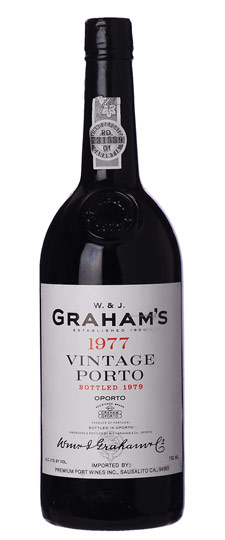
Thus far it's been all history and personal taste. So what? This is where the vibes become arithmetic and the rant becomes mechanism design. Walk into any decent liquor store in the West and you'll find a bottle like the one above: a deliciously sweet bottle of ruby port that'll set you back something like $20. A comparably delightful bottle of dry red? That'll be easily twice the cost; more like $70. That's fine for the everyday stuff, but what about the very best? The finest sweet wines a mouth can hold are exemplified by Graham's 1977 vintage port or Royal Tokaji from 1993, both of them sublime; either of those cost a little under $200. As for that Château Lafite Rothschild, a by-word for excellent prestige dry red? Mature vintages from the early 2000s tend to go for a little over $1,000, and the finest vintages from the 1980s go for more like $10,000. I don't know about you, but I don't think I feel like paying 50 times the price for comparable enjoyment.
.jpg?mode=max)
Here's where the ascended wine snob might object. Mavrodaphne, port, and Madeira are all fortified, and Tokaji, some sweet Riesling, and Sauterne are all botrytized: afflicted by the so-called "noble rot" - Botrytis cinerea in its asexual phase, or Botryotinia fuckeliana in its sporing phase - which processes the overripe grapes' acids and draws away enough of the water from the sugar for it to - in some cases - begin crystallizing right on the vine. (In the latter case, it was named in honor of Karl Wilhelm Gottlieb Leopold Fuckel - that's certainly a name I'm rolling around in my mind like a fine Sauterne right now.) Such sweet wines are thus in a different category, while the dry wines are priced on scarcity and aging potential. But that's just it - that objection concedes the argument. You're not paying five times as much for five times the enjoyment - the provenance is of equal stature, so you're shelling out those thousands for scarcity, the appearance of austerity, and the promise of patience; everything, that is, except how much you actually enjoy drinking the stuff. No one lays down sweet wine as a flex - no one needs to. The sweet stuff is cheap precisely because it gleefully commits the only unpardonable sin: being legibly, immediately delicious, right now.
And that's the real mechanism, isn't it? It's got all the marks of costly signaling. It's not really about the wine; it's about being seen - to possible friends and business associates, to potential mates, and to oneself - as refined, rarified, discerning... above it all. Model it as an equilibrium: everyone wants social status, and everyone also wants pleasure, and each person has only so much money to spend on enjoyment. In such a pool where sweetness is legibly pleasant, purchase and enjoyment of that sweetness tells you nothing about the person enjoying it; anyone can send that signal for free, no matter how refined your appreciation of that sweetness might be. To separate from the masses, you must adopt a preference that costs you something to acquire and keeps costing you to retain: a taste that resists you on contact, demands effort and tuition even to acquire it, and guarantees you've spent time, money, and effort hoi polloi can't have spent. Zahavi would have been delighted to see such a clean example of the handicap principle in action. Dryness in wine (and other spirits) is ideal as such a membership badge: unpleasant at first, requiring initiation and tutelage and practice, demanding that you seek out the pleasure in it through repetition - or at least be able to convincingly fake it. It was never just about tracking the quality of the wine - dry wines have just as much craft to them as sweet, but that's not a sufficient explanation for the prevalence nor the trend. Tannins, minerality, structure, nose and heart and tail and swish-then-spit: you'll note that none of that applies much less to a fine vintage port than to an equally fine Bordeaux. It's about tracking how badly people need to be seen as the kind of people who exactingly track quality. As ever, status signaling shows up at the gate, costumed as some kind of objective good taste.
Yes, dryness in wine is a handicap principle par excellence, and the joke is on the wearer of that hard-won badge of status, thrice over, who has paid more for less pleasure: once on the tongue, once at the register, and once before both at the fancy winery: they have purchased the look of discernment at dire cost. Call it [reverse-sour-grapes] - not pretending that the unreachable desideratum is bad, actually, but rather training yourself, at real and ongoing expense, to consider the easily-reached better thing beneath your contempt.

The buried good news is that, having seen this whole dynamic, you can simply refuse to play. For my part, I am a creature who constitutionally would prefer to hold a glass of the better-tasting thing than the higher-status one. The spirit I set out to make, years and years ago in a college kitchen, would have been a raspberry mead: sweet, bright, floral, richly jammy; the platonic form of a thing meant to be enjoyed and shared, not ranked. Rated, maybe. I never managed to make it, but I was lucky enough to happen on a meadery that had had the same idea and had seen it through without getting embarrassed by honey's sweetness. I keep a small reserve of bottles unopened, within which that raspberry mead has pride of place; each bottle has a condition waiting for it, only to be opened on a night worthy of it. Apart from a bottle of Moët that my old thesis advisor handed me after a successful defense, not one of them is dry. They're saved on purpose, sweet on purpose, and most importantly, deferred on purpose. That last is the move that the sugar-disdaining snob can't see - that holding a sweet thing back for the right occasion is a sophistication of its own, and a much warmer one than carefully schooling yourself to forget the appeal of fructose.
So the emperor's wine is sour, and everyone pays a fortune to be told that that's the point, because only trashy people care about sweetness. I'll be curled up here with port and the mead - poorer in status, but richer in everything that reaches a glass or a wallet; I'll be saving those good sweet bottles for nights and graves that deserve them. Drink the sweet thing, if that's what you truly want; come find me and I'll pour you a glass of something you'll like immediately and like more as you understand it better. Life is short, status is fleeting, fashion is often pointless, the right occasion is worth marking as you choose to, and the sweet bottle is $30, tops. Or, you know, don't. I like being able to get the good stuff cheaply... and maybe you'd rather make the status flex?

Comments
Post a Comment