78. Why Everything is a Spring
(Epistemic status: Philosophy of observation and memories of physics. The math is real and the metaphysics are probably reasonably solid too. As usual, morally correct, skipping over some of the finer details. Dedicated with bittersweet fondness for the Integrated Sciences Curriculum program. Even still, everything is a spring.)
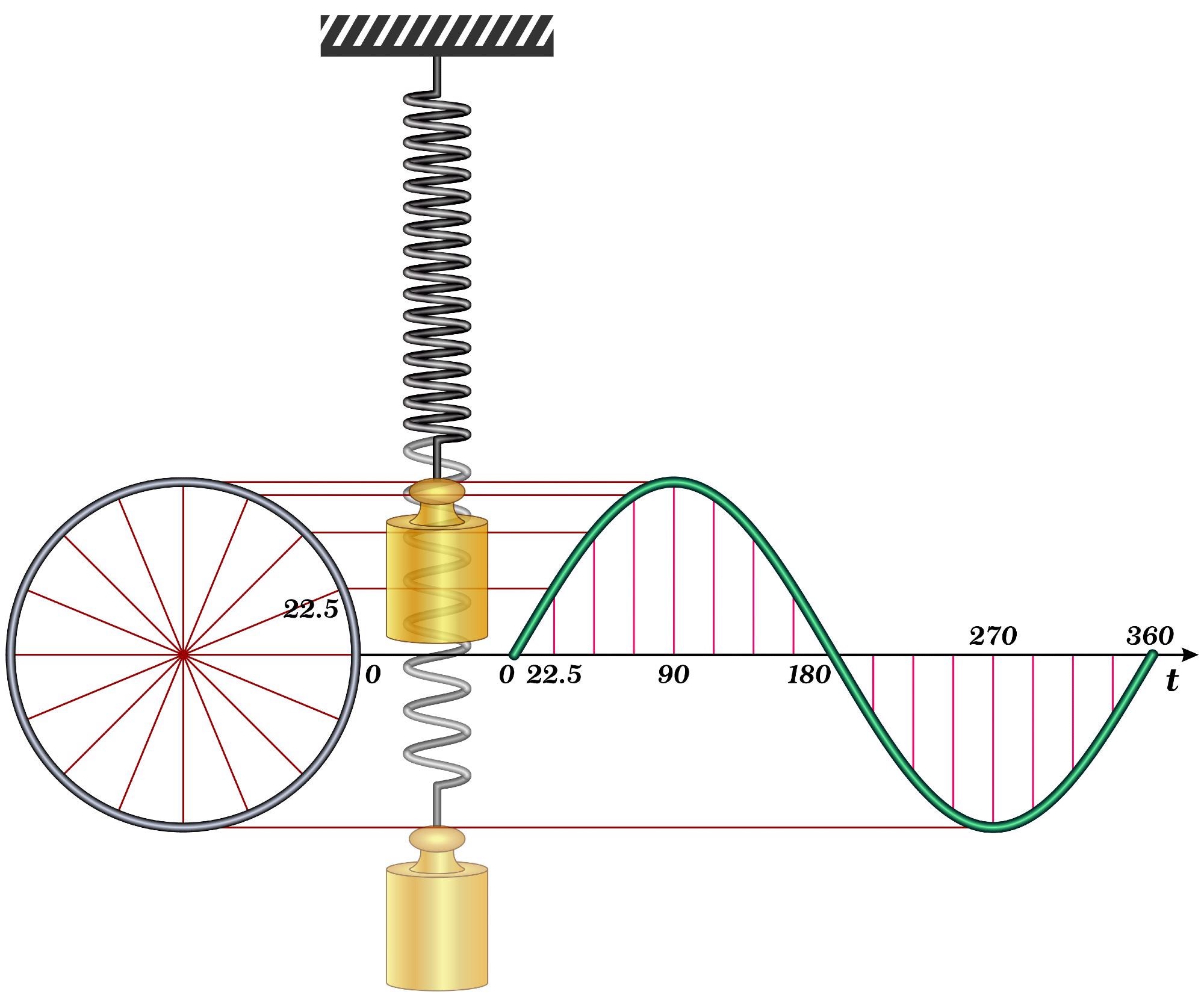
Plucked guitar strings and the quantized modes of trumpet blasts. Carbon dioxide's vibrational modes. Cyclical stock market trends, despite the efficient market hypothesis. The length of a day over the course of a year. These and many other phenomensta should make you ask one simple question: why do so many physical systems like to vibrate? Why are so many such systems well-modelled by reducing them to simple or damped harmonic oscillators? That is: Why is everything a spring?
After years of chewing it over in quiet moments, I've eventually come to a conclusion, and I'm not sure whether it's profound, trivial, both, or some secret fourth thing. It's an essentially anthropic argument: that which sticks around to be observed, and that which sticks around is that which is approximately periodic in time. Naturally, anything whose behavior is roughly constant is trivially periodic, and things that are eventually periodic - that is, with decaying changes or eventual settling down into a more central flavor of periodicity - also count as periodic for the purposes of this argument. It may seem like a facile argument, but take it seriously for a moment. Usually, when we think about physical systems, we neglect to consider the nature of the observer. But regrettably, we are not in fact immortal and patiently observing points of light seeing all there is to see on all timescales (yet! growth mindset!) and are thus incapable of catching things that flicker and are gone on arbitrarily short time scales; similarly, if something happens once, ever, and is then gone, then that's that - the phenomenon has been and gone and we missed it forever. The exceedingly fast and the perfectly aperiodic are both, in effect, forbidden to us to reliably view. But what we can observe is those phenomena which come back, which repeat, if only approximately. Those phenomena which have some kind of stability over time are the province of our observational abilities. Perhaps the universe is brimming with non-periodic, non-oscillatory phenomena of interest - too bad. They don't stick around long enough or repeat often enough for us to build a measurement apparatus to take down that data, so we don't see them, so they're not a part of our phenomological understanding of the universe. And that leaves us, of course, with springs.
That's all a necessary condition supporting my argument, sure. But it's not sufficient. Why should "sticking around" entail specifically periodicity, let alone damped oscillation? Why don't we simply see a universe at max entropy, a world of stable equilibria all fallen down their respective energy landscapes to sit peacefully at eternal rest? Here's where the math gets interesting and the metaphysics gets properly weird. On the math side, consider a system with an equilibrium point, where all the forces balance, the system wants to stay put. Nudge the system a little however you like, but just a little. What happens? Well, by assumption the equilibrium is a stable one - and it must be, as the universe is not still dead crystalline perfection (yet? growth mindset?) and so whatever this system is has surely taken knocks of comparable or greater size before. In other words, the whole thing is a stable rather than an unstable equilibrium - the bottom of a bowl, not the top of a dome, in the energy landscape. Small perturbations, then, give rise to restoring forces, pulling the system back towards equilibrium. Without damping, we now have a simple harmonic oscillator; with damping of various sorts, we have a damped harmonic oscillator. In either case, the system has a momentum (or whatever equivalent) to it now, at least at the start, and it overshoots the equilibrium point, creating another (likely smaller) restoring force in the opposite direction. And so on, and so on, and so on.

And what of the metaphysics? Those, I can sum up with a classic aphorism: "if the universe were simple enough for us to understand it, we would be simple enough that we couldn't.". Or looked at another way: if the universe were already at max entropy, there would be nothing for cognition to feed on, and we would not be here wondering why the universe was finally at heat death.
The answer is the same in any event: everything is a spring because the universe has not ended (yet? growth?? mindset???), and we are here to observe the thing, and everything that isn't a spring either flew apart already or never came together to start with.
Here's where it gets especially weird: quantum mechanics. (No, no, don't leave, I'm not that kind of crazy! The burrow-door's already locked, though. You're here for the math and physics, like it or not.) I'm talking about periodicity in space, rather than time, and thus in more dimensions than just one. To begin with, think about a drumhead. Those don't ring out in pure tones and their higher harmonics in the same way that you get from vibrating strings and columns of air. But there's still a different sound they make when you hit them harder... somewhat higher-pitched somehow, but harder to characterize. This is because drums obey similar but distinct harmonic laws to all those one-dimensional systems. They obey two-dimensional harmonic laws - spherical or cylindrical harmonics, also called Bessel functions.
And it's just those spherical harmonics that give rise to the shapes of (e.g.) electron orbitals. Let's hop back to the 1D case for a moment. Here, the equivalent to spherical and cylindrical harmonics are vibrations constrained to a circle and line segments with fixed endpoints, respectively. Their possible modes of vibration are quantized - they have to be some fixed integer multiple of a fundamental frequency, fitting some integer (or half-integer, for the line case) number of wavelengths into the physical space that the vibrating system occupies. You can fit 2 or 5 or 34 wavelengths in, but not 1.5 or π - those effectively cancel themselves out. This is why trumpets have specific notes - their higher partials - rather than a continuous spectrum of sound such that the harder you blow, the higher the note you get, in some smooth way.

Alright, enough of that. Jump back to the more complex case. Instead of vibrations on a circle - \(S^1\) - consider vibrations on a sphere - \(S^2\). The possible vibrational modes are, again, spherical harmonics: those satisfying but odd-looking forms that you see in electron orbitals in quantum chemistry, and in the cosmic microwave background. Most notably, the shapes of electron orbitals as you see them in undergrad chemistry are a classic pedagogical lie: the true shape of them is much more clearly rotationally symmetric, as any physicist worth their oversimplifying scoff can tell you. In particular, the amplitudes are complex-valued, not real valued, while the simplified images they give chemistry students mark out the surface within which 90% of the electron's probability density lies, along with the sign of the wavefunction (which is in this case irrelevant for probability).

And this is why those orbitals look the way they do: electrons in an atom aren't little billiard balls orbiting a nucleus. (For one, they'd have to be going much too fast, to avoid falling into the nucleus, and also Heisenberg would frown disapprovingly.) They're standing waves - vibrations confined to spherical volumes of space centered on the nucleus. This quantization isn't some mysterious inherently quantum property - just the natural result of waves bounded to a sphere.
A thesis-brother once remarked on how "sacred geometry" kooks wish they could make anything as beautiful as we did, playing around with hyperbolic tilings. I felt and still feel that, and I feel that way here, too: everything is made of vibrations and harmonic oscillators, damped or simple, but in a far more elegant and beautiful and structured way than any "quantum vibration healer" ever dreamt of in their pipes. You can't unsee it once you've started seeing it - so I said to a undergrad calculus student who asked me how math shows up in my life; I told him of the comfort of the wheel of the year, of the gentle sinusoidal curve that the lengths of daytimes over the course of the seasons trace out. Atoms are largely made of vibrations of electron fields; molecules are what happens when those vibrations sync up in the right way. Light is made of vibrations in the electromagnetic field. Sound is made of vibrations in air (or some other medium), obviously, and heat is made of frantic vibrations of molecules - how do you think microwaves work?
And it doesn't stop there. Atomic clocks work by counting vibrations of (usually) cesium atoms, and more prosaic watches work by counting vibrations of voltage in tormented quartz crystals. (Take that, Chopra!) Spectroscopy works by measuring which frequencies of light the molecules in a sample absorb and emit, which ones reinforce their jittering or pass right through it. And if you bother that physicist again, they might well give up a grand secret of quantum field theory: that everything is an excitation in a universal field - that is, a vibration in a characteristic (metaphorical) medium.
We didn't need to assume much, to get here. We just needed to pay very careful attention to the whats and the whys and the hows, and chase those answers wherever they led us. And I think about this, whenever I'm trying to build or understand something complex. It's not just behavior at equilibrium you need to concern yourself with - it's behavior just a tad away from equilibrium, too, and the natural frequency of the system's resulting oscillations. What modes of oscillation does the system support, near but not quite at equilibrium? What are the resonances? How does it change when perturbed as the system irritably seeks equilibrium again?
Every stable structure has characteristic periods, characteristic frequencies at which they naturally vibrate. Every organization has its rhythms - the daily, weekly, monthly, seasonal, or yearly patterns emerging from its structure. Every person and every persistent relationship has natural cycles - circadian, emotional, creative, or energetic. They are there, they are real, and they are what exists to be interacted with, not some simplified fantasy of invariance. Ignore them at your peril.
Because you can't fight the springs. They're not an implementational quirk or an occasional novelty, but rather fundamental to anything that persists over time and which changes at all while ever returning to how it began. So - if you mean to design anything and want it to last, be it a building, a process, a relationship, a machine, or a life, be mindful that you're not designing something static and fixed, but something that must account for ordered swaying and bending. Will the oscillations tear apart what you've built, or allow it to persist? Everything is a spring, and whether your works last depends on how seriously you've taken that truth.

Comments
Post a Comment