49. A Partial Theory of Flavor Pairing in Foodcraft
(Epistemic status: only partially worked out, lots of handwaving, still not something I've seen talked much about explicitly anywhere.)
(With thanks to JSW, PR, RG, MR, and JM, among others, who asked for this. If you asked me for this out of the list, it's for you.)
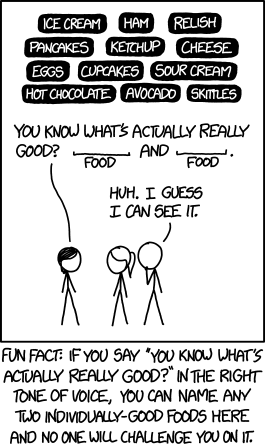
Food and drinks have flavors [citation needed]. In fact, they have lots of flavors - careful tasting of an ordinary bottled barbecue sauce presents sweetness and tartness and savoriness, and beneath those, tomato and molasses, and beneath those - if you get that far - mustard seed and paprika and onion powder and "some kind of fish sauce???". (It's Worcestershire sauce.) Some flavors blend nicely, like onion and garlic, while others clash, like onion and pineapple. But then some very different flavors pair just fine, like apples and cinnamon, or vanilla and nearly anything you'd find in a dessert. And even onion and pineapple go together just fine in the greater context of a salsa, or even a pizza! So what's going on?
Here's a stab at explaining why. I'll use "food" as a term of art to mean anything intended to be eaten and enjoyed. A food flavor is comprised of two major parts: its tastes (sweet, salty, spicy, all the basic and chemosensory types) and its flavors (individual odorants, mostly associated with specific ingredients like cumin, tomato, or beef). On top of that, we have things like its context (what's the nature of the larger mixture? is it a dessert? a stew?), its temperature, and the relative concentration of flavors, and to a lesser extent modifiers like how cooked it is (caramelized, raw, normally cooked as "blurs out and turns up the gain" on flavors), what solvent it's in (water, alcohol, fat), the physical properties of the substrate (is it crunchy? soft? liquid?), and what expectations you have when tasting the food.
On my model, a combination of flavors tastes at least OK if at least one of three things is true, and generally better with more of them satisfied. The combination can call back to a known tasty food, it can have satisfying blending with no bad clashes, and it can have interesting bistable contrasts with independently good-but-maybe-overstrong components.
The first of these, the Rule of Familiarity, is the simplest to explain. A food will probably taste OK if the flavors in it match closely to the major notes of a known and beloved dish and the presentation of the food isn't too terribly different. This is the operating principle behind any fussy "deconstructed" food: you take the components of a dish and permute or alter their order or presentation while leaving the basic notes intact, as well as the general presentation. Maybe you also really sell the phenomenological binding by adding some additional element that would classically go with the dish, just to control expectations a little. Take the example of a deconstructed apple pie. Turn the apple filling to a reduction sauce and swap crust for an artful bed of crumbs. Make very sure that the apple sauce has a bit of molasses and cinnamon in it, maybe some other pie spices. Apple pie's easy for presentation, since it's served both hot and cold, but if you really want to sell the effect, serve it with the sauce piping hot with a scoop of vanilla ice cream alongside. It'll be... fine. Sell it for 30 bucks a plate. (Give me a proper slice of pie any day, though.) Almost every food can be done up this way - dishes have major ingredients that people will expect, expected form factors or temperatures to serve them at, and expected roles that need to be filled. Match those well enough and you probably end up with something good.
The second, the Rule of Harmony, is a little trickier: there is a need for satisfying blending. A food will probably taste OK if any given pair of flavors in it blend satisfyingly, and no pair of ingredients clashes. On this model, a pair of flavors blends well if they share flavor chemicals; the more, the better the blend. Thus: onions and garlic, vanilla and most (but not all!) sweet flavors, and meat with anything savory, like tomato. This also helps explain what's going on with spices: they're almost pure flavor, and frequently contain flavorant chemicals that they share in common with ingredients. This in particular is why vanilla and chocolate see such wide appeal, and why rose was once the standard for desserts before vanilla: their chemical makeups are exceedingly complex and multifaceted, having some degree of commonality with a wide variety of different ingredients. This is also why oak is used for wine casks: it too contains vanillin. Alternately, we might contrast the sense of "blending" here with "masking", where "masking" should be taken to mean an attempt to force a fit by moving as far as possible to one extreme of the bistable spectrum; this rarely works out well. For instance, certain intoxicatingly herbed pastries frequently contain lots of chocolate in a doomed attempt to mask the taste. Better to work with the terrain rather than against it, to blend the flavor in instead - from personal experience I can recommend a nice quiche Florentine, whose heavy spinach component blends much better with bitter green flavors, especially alongside the base of pleasantly sulfurous Gruyere cheese and eggs, with onions, garlic, and perhaps some bacon all indicated.
Lastly, the Rule of Interesting Contrasts. A food will probably taste OK if it has some kind of interesting bistable contrast in it and it's made of individually good-but-maybe-overstrong components - and, again, no bad clashes. By bistable here I refer to an effect that can be achieved straightforwardly with careful balances of pairs of distinct tastes or even flavors, where we note that (e.g.) with a combination of salty and sweet, at one extreme the mix is just salty, at the other it's just sweet, but at some point in between, finely graded concentration differences and habituation effects give rise to the sensation of a taste that seems to flip back and forth between the two components. This is the operating principle behind trail mix: people generally like some subset of dried fruit, chocolate, beef jerky, cheese crackers, assorted nuts, and the like. (It's also the operating principle behind any cursed combination of foods that's "surprisingly good".) Each of them hits all the expected marks for being individually enjoyable - one or more of salt, sugar, and fat; individually enjoyable flavors; pleasant texture and form factor; all that good stuff. Also, for any given pair of those, there's one or both of a difference in taste - covering both sweet and salty - and a reasonably compatible difference in flavor (e.g. meat and fruit). Here we find a deep secret of foodcraft: never neglect the acid. A little tartness is a vital component of almost any food, and I hypothesize that a part of why is its capacity to play a supporting role to contrast well with sweet, fatty, and salty alike.
As with any art, the rules are not ironclad, and they can be broken to good effect. Neither are they universal: a combination of shrimp paste and pears might disgust you, but to the Indonesian palate, it evokes delicious rojak. Another is the rule against bad clashes: on this model, the reason why onion and pineapple go just fine together in a salsa is that the onion pairs excellently with the tomato (itself arrogating the savoriness of meat, along with salt), and the pineapple serves the role of adding sweetness and tartness, supporting the salsa as a whole rather than pairing with any specific ingredient; the same is generally true of any dish where one ingredient sticks out as particularly weird, and likewise, there likely ultimately exists no pair of ingredients that cannot be made to go together somehow in some dish. From this we might posit that the Rule of Familiarity can override some minor clashes, if one of the clashing ingredients is core to the dish, the other is serving some role, and the clash is merely not enjoyable rather than actively offensive. Conversely, the "Incompatible Food Triad" - three ingredients that go together well pairwise but not as a triple - points the way to what looks like a puzzling inconsistency, but we might resolve the seeming paradox by pointing out that in such cases, any pair of the three evokes a very different dish, with the third having no place in it at all. That said, even the foremost research into Incompatible Food Triads has failed to turn up any particularly clean or striking examples of one, the closest being yogurt, salted cucumber, and sugar - breakfast yogurt, tzatziki, and sweet pickles are each perfectly fine dishes, but they pull in very different directions.
Using the principles expounded here, you can start composing your very own dishes. My specialties are generally of this sort: I've made a delicious beef stew halfway between an English-style stew and a boeuf borguignon; I've made a variant on cinnamon buns that uses plenty of Chinese five-spice powder, on top of the use of tangzhong dough preparation, to approval from Grandma Kim and numerous friends alike; and I've swapped out the broccoli in various dishes with Romanesco cauliflower to cheers. People ask me how I think of these substitutions, but considered rightly in a frame that this post partially illuminates, they all constitute natural alterations. Go make something delicious of your own!
(With thanks to JSW, PR, RG, MR, and JM, among others, who asked for this. If you asked me for this out of the list, it's for you.)
Food and drinks have flavors [citation needed]. In fact, they have lots of flavors - careful tasting of an ordinary bottled barbecue sauce presents sweetness and tartness and savoriness, and beneath those, tomato and molasses, and beneath those - if you get that far - mustard seed and paprika and onion powder and "some kind of fish sauce???". (It's Worcestershire sauce.) Some flavors blend nicely, like onion and garlic, while others clash, like onion and pineapple. But then some very different flavors pair just fine, like apples and cinnamon, or vanilla and nearly anything you'd find in a dessert. And even onion and pineapple go together just fine in the greater context of a salsa, or even a pizza! So what's going on?
Here's a stab at explaining why. I'll use "food" as a term of art to mean anything intended to be eaten and enjoyed. A food flavor is comprised of two major parts: its tastes (sweet, salty, spicy, all the basic and chemosensory types) and its flavors (individual odorants, mostly associated with specific ingredients like cumin, tomato, or beef). On top of that, we have things like its context (what's the nature of the larger mixture? is it a dessert? a stew?), its temperature, and the relative concentration of flavors, and to a lesser extent modifiers like how cooked it is (caramelized, raw, normally cooked as "blurs out and turns up the gain" on flavors), what solvent it's in (water, alcohol, fat), the physical properties of the substrate (is it crunchy? soft? liquid?), and what expectations you have when tasting the food.
On my model, a combination of flavors tastes at least OK if at least one of three things is true, and generally better with more of them satisfied. The combination can call back to a known tasty food, it can have satisfying blending with no bad clashes, and it can have interesting bistable contrasts with independently good-but-maybe-overstrong components.
The first of these, the Rule of Familiarity, is the simplest to explain. A food will probably taste OK if the flavors in it match closely to the major notes of a known and beloved dish and the presentation of the food isn't too terribly different. This is the operating principle behind any fussy "deconstructed" food: you take the components of a dish and permute or alter their order or presentation while leaving the basic notes intact, as well as the general presentation. Maybe you also really sell the phenomenological binding by adding some additional element that would classically go with the dish, just to control expectations a little. Take the example of a deconstructed apple pie. Turn the apple filling to a reduction sauce and swap crust for an artful bed of crumbs. Make very sure that the apple sauce has a bit of molasses and cinnamon in it, maybe some other pie spices. Apple pie's easy for presentation, since it's served both hot and cold, but if you really want to sell the effect, serve it with the sauce piping hot with a scoop of vanilla ice cream alongside. It'll be... fine. Sell it for 30 bucks a plate. (Give me a proper slice of pie any day, though.) Almost every food can be done up this way - dishes have major ingredients that people will expect, expected form factors or temperatures to serve them at, and expected roles that need to be filled. Match those well enough and you probably end up with something good.
The second, the Rule of Harmony, is a little trickier: there is a need for satisfying blending. A food will probably taste OK if any given pair of flavors in it blend satisfyingly, and no pair of ingredients clashes. On this model, a pair of flavors blends well if they share flavor chemicals; the more, the better the blend. Thus: onions and garlic, vanilla and most (but not all!) sweet flavors, and meat with anything savory, like tomato. This also helps explain what's going on with spices: they're almost pure flavor, and frequently contain flavorant chemicals that they share in common with ingredients. This in particular is why vanilla and chocolate see such wide appeal, and why rose was once the standard for desserts before vanilla: their chemical makeups are exceedingly complex and multifaceted, having some degree of commonality with a wide variety of different ingredients. This is also why oak is used for wine casks: it too contains vanillin. Alternately, we might contrast the sense of "blending" here with "masking", where "masking" should be taken to mean an attempt to force a fit by moving as far as possible to one extreme of the bistable spectrum; this rarely works out well. For instance, certain intoxicatingly herbed pastries frequently contain lots of chocolate in a doomed attempt to mask the taste. Better to work with the terrain rather than against it, to blend the flavor in instead - from personal experience I can recommend a nice quiche Florentine, whose heavy spinach component blends much better with bitter green flavors, especially alongside the base of pleasantly sulfurous Gruyere cheese and eggs, with onions, garlic, and perhaps some bacon all indicated.
Lastly, the Rule of Interesting Contrasts. A food will probably taste OK if it has some kind of interesting bistable contrast in it and it's made of individually good-but-maybe-overstrong components - and, again, no bad clashes. By bistable here I refer to an effect that can be achieved straightforwardly with careful balances of pairs of distinct tastes or even flavors, where we note that (e.g.) with a combination of salty and sweet, at one extreme the mix is just salty, at the other it's just sweet, but at some point in between, finely graded concentration differences and habituation effects give rise to the sensation of a taste that seems to flip back and forth between the two components. This is the operating principle behind trail mix: people generally like some subset of dried fruit, chocolate, beef jerky, cheese crackers, assorted nuts, and the like. (It's also the operating principle behind any cursed combination of foods that's "surprisingly good".) Each of them hits all the expected marks for being individually enjoyable - one or more of salt, sugar, and fat; individually enjoyable flavors; pleasant texture and form factor; all that good stuff. Also, for any given pair of those, there's one or both of a difference in taste - covering both sweet and salty - and a reasonably compatible difference in flavor (e.g. meat and fruit). Here we find a deep secret of foodcraft: never neglect the acid. A little tartness is a vital component of almost any food, and I hypothesize that a part of why is its capacity to play a supporting role to contrast well with sweet, fatty, and salty alike.
As with any art, the rules are not ironclad, and they can be broken to good effect. Neither are they universal: a combination of shrimp paste and pears might disgust you, but to the Indonesian palate, it evokes delicious rojak. Another is the rule against bad clashes: on this model, the reason why onion and pineapple go just fine together in a salsa is that the onion pairs excellently with the tomato (itself arrogating the savoriness of meat, along with salt), and the pineapple serves the role of adding sweetness and tartness, supporting the salsa as a whole rather than pairing with any specific ingredient; the same is generally true of any dish where one ingredient sticks out as particularly weird, and likewise, there likely ultimately exists no pair of ingredients that cannot be made to go together somehow in some dish. From this we might posit that the Rule of Familiarity can override some minor clashes, if one of the clashing ingredients is core to the dish, the other is serving some role, and the clash is merely not enjoyable rather than actively offensive. Conversely, the "Incompatible Food Triad" - three ingredients that go together well pairwise but not as a triple - points the way to what looks like a puzzling inconsistency, but we might resolve the seeming paradox by pointing out that in such cases, any pair of the three evokes a very different dish, with the third having no place in it at all. That said, even the foremost research into Incompatible Food Triads has failed to turn up any particularly clean or striking examples of one, the closest being yogurt, salted cucumber, and sugar - breakfast yogurt, tzatziki, and sweet pickles are each perfectly fine dishes, but they pull in very different directions.
Using the principles expounded here, you can start composing your very own dishes. My specialties are generally of this sort: I've made a delicious beef stew halfway between an English-style stew and a boeuf borguignon; I've made a variant on cinnamon buns that uses plenty of Chinese five-spice powder, on top of the use of tangzhong dough preparation, to approval from Grandma Kim and numerous friends alike; and I've swapped out the broccoli in various dishes with Romanesco cauliflower to cheers. People ask me how I think of these substitutions, but considered rightly in a frame that this post partially illuminates, they all constitute natural alterations. Go make something delicious of your own!

Comments
Post a Comment